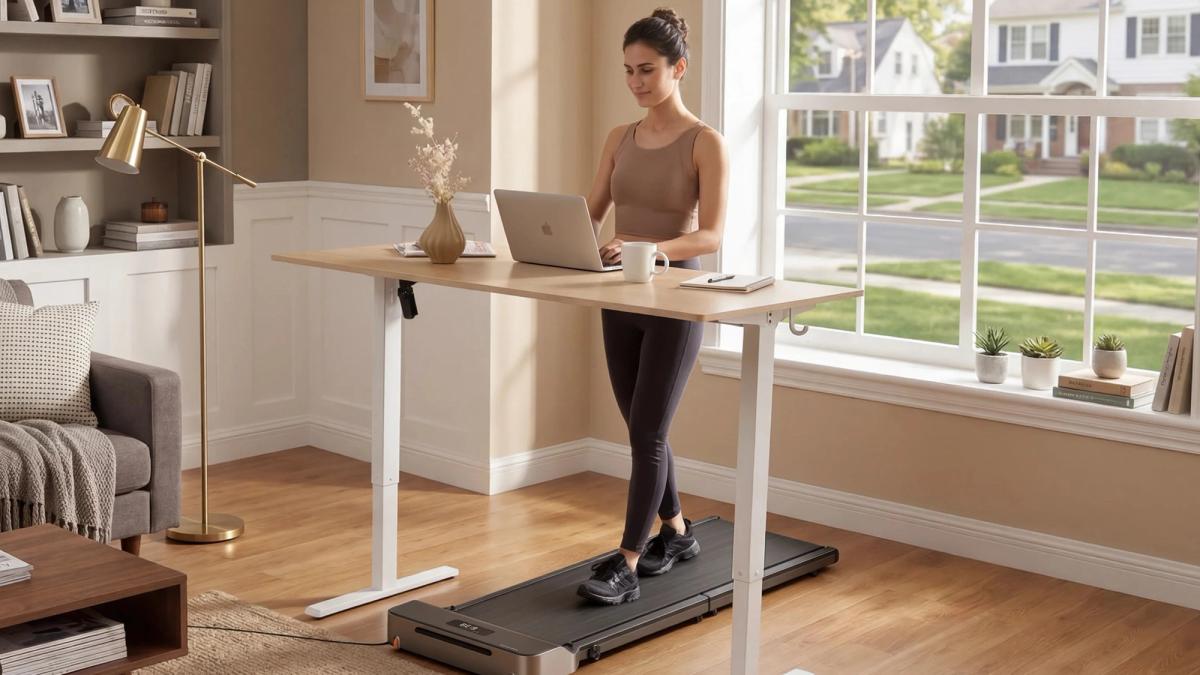
Why walking pads qualify for HSA/FSA
A walking pad gives you a way to replace long seated stretches with regular indoor walking, including during your workday. When those walks are part of managing a health condition, your Letter of Medical Necessity (LMN) documents the connection between the equipment and your care.
IRS Publication 502 defines medical expenses to include the costs of “diagnosis, cure, mitigation, treatment, or prevention of disease.” Walking for general fitness is a personal expense. A licensed provider connects the walking pad to your condition in your Letter of Medical Necessity, and that is what makes it HSA/FSA eligible.
Walking pads are compact treadmills designed around walking. Some fit beneath a desk, some fold for storage, and some add incline. The useful feature is having a walking surface you can use consistently for the purpose your provider recommends.
Which conditions can support a walking-pad LMN?
A walking-pad letter connects a specific condition to a practical walking routine. Your provider can describe the pace, duration and support that suit you, whether you want short workday walks or dedicated sessions away from your desk.
- Type 2 diabetes. Walking can help manage blood sugar. A PLOS ONE meta-analysis of 20 trials involving 866 participants found that walking programs lowered HbA1c by 0.50 percentage points overall. The review supported supervised walking or walking with motivational strategies. A pad can make scheduled indoor walks easier to keep up with.
- Obesity. Walking adds activity and uses energy as part of a weight-management plan. NIDDK recommends walking and other physical activity alongside healthy eating to help control weight. A compact pad gives you an indoor option when fitting a walk around work is the practical challenge.
- High blood pressure. A Cochrane review of 73 trials found that walking probably lowers systolic blood pressure. Most programs used moderate-intensity walking, the pace a walking pad is built for.
- Knee osteoarthritis. NIAMS includes walking among low-impact activities for osteoarthritis. Exercise can help with joint pain, stiffness and function. A provider can recommend a comfortable walking routine and the support you need on the moving belt.
- Depression. A BMJ systematic review found that walking or jogging reduced depression symptoms. A walking pad offers a repeatable indoor activity that your provider can include in your care plan.
How to get your LMN for a walking pad
You can get a Letter of Medical Necessity for a walking pad two ways: online through Crates, or from your own doctor.
- Through Crates, typically in under 24 hours. Once you finish the 2 to 3 minute online health assessment, a licensed provider reviews it and issues your walking-pad letter if you qualify. Your letter lasts 12 months and renews each year.
- Through your own doctor, a few days to a few weeks. Book a visit, say you want to buy a walking pad with HSA/FSA funds, and ask your doctor to document how it helps prevent, manage, or reverse your condition. Check that your doctor's signature and the date are on the letter. Your visit might have a copay.
How to buy a walking pad with HSA/FSA funds
Buy your walking pad wherever you like, online or in a store, then get your HSA/FSA funds back in three steps:
- Get your Letter of Medical Necessity first. Use either route above, Crates or your own doctor, before you buy.
- Buy the walking pad anywhere. Pay with your personal card and keep the itemized receipt showing the model, purchase date and amount paid.
- Get your funds back. Choose Crates one-click reimbursement and we'll file your claim, or upload the letter and receipt yourself. For an HSA, you can reimburse yourself and keep both documents with your tax records.
IRS Publication 969 explains the timing and recordkeeping rules: an HSA expense must arise after the account is established, while an FSA purchase falls within your coverage period and filing deadlines. For a comparison of the two accounts, read our HSA vs. FSA guide.
Which walking pad should you buy?
Choose the walking pad that fits your documented walking plan and the space where you will use it. The medical purpose and your letter decide eligibility; a folding belt, quieter motor or incline setting helps you choose the equipment that suits your day.
| Brand | Known for | Eligible with an LMN |
|---|---|---|
| DeerRun | Compact walking pads, including incline and folding options | Yes |
Any brand works the same way when your provider recommends its walking pad for your condition. Compare the actual belt dimensions, user-weight limit and operating instructions rather than buying on the brand name alone.
Match the pad to your space and routine
| Walking-pad type | Useful for | What to compare |
|---|---|---|
| Under-desk treadmill | Walking while working at an adjustable desk | Clearance between the desk legs, belt height and easy-to-reach controls |
| Folding walking pad | Moving the pad out of a shared room after use | Folded dimensions, lifting weight and the maker's storage instructions |
| Incline walking pad | Adding uphill walking to a recommended routine | Available incline settings, stability and whether the model fits beneath your desk |
These features can overlap: a folding pad may also fit under a desk. Check the walking belt's usable length and width, especially if you have a long stride. Compare noise at the speed you expect to use, and make sure you can reach the stop control without leaning across your desk. If your routine calls for handrail support, choose a model with suitable rails and check that they clear the desk.
A pad raises your standing height, so account for the belt when setting your keyboard and screen. If you are building a walk-and-work setup, our standing-desk HSA/FSA guide covers the desk that pairs with it. Start at a comfortable pace and give yourself room to step off according to the model's instructions.
If your plan includes regular running or you want a larger machine, our treadmill HSA/FSA guide covers full treadmills.
How much can HSA/FSA save on a walking pad?
At a combined rate near 30%, an illustrative $300 eligible walking pad represents about $90 in avoided taxes, for an effective after-tax cost of $210. The retailer still charges $300. Reimbursement uses your own account funds; the savings come from their tax advantages.
Each column multiplies the purchase price by the illustrated tax rate:
| Illustrative walking-pad price | Savings at a combined 20% rate | Savings at a combined 30% rate | Savings at a combined 40% rate |
|---|---|---|---|
| $150 | $30 | $45 | $60 |
| $300 | $60 | $90 | $120 |
| $600 | $120 | $180 | $240 |
These prices are examples, not current offers. The combined rates represent federal income tax, state income tax and payroll taxes where applicable. Publication 969 explains the accounts' tax advantages; your actual benefit depends on your taxes and contribution arrangement. Provider or LMN fees are separate from the walking-pad prices shown.